Wednesday, June 20, 2007

Leonardo Da Vinci


Okay, I am a big fan of his work..... are not we all.

Here are seven strategies to be more like Leonardo.

* Curiosity An insatiably curious approach to life.
* Demonstration: A commitment to test knowledge through experience.
* Sensation: The continual refinement of the senses, especially sight, as the means to clarify experience.
* Sfumato: A willingness to embrace ambiguity, paradox, and uncertainty.
* Art|Science: The development of the balance between science and art, logic and imagination ("whole-brain thinking").
* Cultureç The cultivation of ambidexterity, fitness, and poise.
* Correctedness: A recognition and appreciation for the connectedness of all things and phenomena; "systems thinking."

Saturday, June 16, 2007

June 13 - Les Baux de Provence


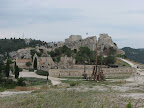
Les Baux de Provence is a small village in southern France.in the former province of Provence. It has a spectacular position in the Alpilles mountains, set atop a rocky outcrop crowned with a ruined castle overlooking the plains to the south. Its names refers to its site — in Provence, a baou is a rocky spur.

It was built primarily as a defence structure as it was high a top the mountain and could easily launch flaming projectiles as a means of defence.

June 16 - Nice is Nice

Nice is down time for us. Luc is very tired of the marathon visiting so is looking forward to sitting on a beach on the the Mediterranean coast.

We are off to Antibes today as it is less busy then Nice and hopefully a little more down to earth. The play ground for the uber rich is not really my style.


June 13 Arles, France


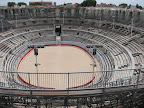
Arles is famous for two things that we saw. There is probably more but we only spent a few hours in the city. The Roman Arena and many of Vincent Van Gogh's paintings were of this city.

June 13 - Pont du Gard


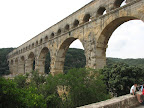
Pont du Gard was built around the year 19 BC. The aquaduct was designed to carry the water across the small Gardon river valley, it was part of a nearly 50 km (31 mi) aqueduct that brought water from springs near Uzès to the Roman city of Nemausus (Nîmes). At the time it was built, Nimes (France) was one of the bigger Roman centers. The Pont du Gard is the second largest Roman structure every built. It is 1 yard shorter then the Roman Coliseum in Rome. Water was a source of survival and luxury. The Romans at that time had quite complex plumping, even suction pumps to have high pressure water running through the pipes and into fountains.

Wednesday, June 13, 2007

June 12 - Avignon - Palais des Papes

Avignon is probably best known for its Palais des Papes (Palace of the Popes), where the Popes lived for much of the 14th century from 1309 - 1377 known as the Avignon Papacy.

Seven popes resided in Avignon:

Pope Clement V
Pope John XXII
Pope Benedict XII
Pope Clement VI
Pope Innocent VI
Pope Urban V
Pope Gregory XI

In all in tense purposes, the head of the Catholic church could have been centered in Avignon instead of Rome. After being expropriated following the French Revlolution, the Palais des Papes was used as barracks for many years but is now a museum.

Avignon has a walled city which was built by the popes to keep the papal territory well preserved.

June 12 - Carcassonne

Carcassonne is a fortified French town. It is separated into the fortified Cité de Carcassonne and the more expansive lower city, the ville basse. The fortress, which was thoroughly restored from 1853 by the theorist and architect Eugène Viollet-le-Duc, was added to the UNESCO list of World Heritage Sites in 1997. For more information on this wonderful city, please go to the website at http://www.carcassonne.org/

June 12 - Millau Viaduct

The Millau Viaduct is a large cable-stayed road-bridge that spans the valley of the River Tarn near Millau in southern France. It is the tallest vehicular bridge in the world, with one pier's summit at 343 metres (1,125 ft)—slightly taller than the Eiffel Tower and only 38 m (125 ft) shorter than the Empire State Building. It was formally dedicated on 14 December 2004 and opened to traffic two days later.

The bridge’s construction broke three world records:

- The highest piles in the world: piles P2 and P3, 244.96 and 221.05 metres in height respectively, broke the French record previously held by the Tulle and Verrières Viaducts (141m), and the world record previously held by the Kochertal Viaduct (Germany), which peaked at 181 metres;

- The highest mast in the world: the height of the mast atop pile P2, peaks at 343m.

- The highest road bridge deck in the world, which is 270m above the Tarn River at its highest point. Only the bridge deck of the Royal Gorge Bridge (321m) in Colorado, United States is higher, and is considered the highest bridge in the world, but is only open to pedestrian traffic.

June 12 - Saint-Émilion

Went to a town just 40 km east of Bordeaux called Saint-Émilion. Saint-Émilion's history goes back to prehistoric times and is a World Heritage site, with fascinating Romanesque churches and ruins stretching all along steep and narrow streets.


The Romans planted vineyards in what was to become Saint-Émilion as early as the 2nd centrury AD. In the 4th century , the Latin poet Ausonius lauded the fruit of the bountiful vine.
The town was named after the monk Émilion, a travelling confessor, who settled in a hermitage carved into the rock there in the 8th century. It was the monks who followed him that started up the commercial wine production in the area.


Saint-Émilion is one of the four principal red wine areas of Bordeaux (the others being Médoc, Graves and Pomerol). The same grape varieties tend to be used but in a different ratio, with Merlot and Cabernet Franc predominating, while relatively small amounts of Cabernet Sauvignon are used. The region is much smaller than the Médoc and adjoins the wine region of Pomerol.

Migron, France

My uncle Hubert has tracked down our lineage to the 1700's to the town of Migron, France. It is in the peaceful, ancient village of Migron, in the heart of the Cognac/Pineau producing area, and is surrounded by acres of vineyards and sunflowers.

Migron is about 150 km north of Bordeaux, France.

I will have to put more information about our lineage here.

June 11 - Dune du Pyla

Went to Dune du Pyla which 60Km from Bordeaux, in the South of the Arcachon Bay, which is the highest dune in Europe, the Great Dune of Pyla. This dune reaches a height of 107m. At this summit, the view is spectacular with the ocean coast, the inlet of the Bay, the large pine forest and, when the sky is very clear, the Pyrenees Range. This is a great place for parasailers to take off and land from as you can see in the slideshow.

June 11 - Arcachone

In the morning headed off to Arcachon. Arcachon is a great place to visit if you want beautiful beaches and a nice resort town. Arcachon is a popular watering-place, with a fine beach and a mild climate on the Atlantic coast of southwest France 55 kilometers miles southwest of Bordeaux.

June 11 - Bordeaux


Bordeaux is the main wine making region of France. We spent the night here but were tired from all the traveling so we only took a look at some of the central squares. Really did not have time to enjoy Bordeaux's full beauty. In the morning headed off to Arcachon, which is a beautiful resort town on the Atlantic ocean.

Train from Bergisch Gladbach, Germany

June 10

We took the local train from Bergisch Gladbach to Cologne, Germany. From there we caught the Thayls train to Paris, France. Took the Metro from Gard du Nord to the Gard MontPellier station. From there caught the TGV to Bordeaux. In toll, it was about 8 hours travel time mainly on Trains.

Saturday, June 9, 2007

Rhine River Cruise - June 9 - Kulb to Braubach

Today after the tour of the Marksburg castle at Braubach, we took a train to Kulb and got on the Klön - Düsseldorfer Rhine Cruises. Their website is at http://www.k-d.com.

There are many beautiful small towns that we saw on the Rhine river such as St. Goarshausen, St. Goar, Boppard, and Braubach. There are the most castles in this area as well. We saw a number of them. On the hills of the Rhine valley are many vineyards which produce the great wine of the Rhine valley.

Friday, June 8, 2007

Cologne Germany - June 9 - Marksburg Castle


We are off to the Marksburg Castle with Ruth and Fritz. Fritz loves taking everyone to the castle.


The Marksburg is a castle above the town of Braubach in Rhineland-Palatinate, Germany. It is the only medieval castle of the Middle Rhine that has never been destroyed. It is one of the principal sites of the UNESCO World Heritage Rhine Gorge.

The castle was built to protect the town of Braubach and to reinforce the customs facilities. It was built about 1117 and explicitly first mentioned in 1231.


You can find more information at http://www.marksburg.de/default.htm

Cologne Germany - June 8

We are in Cologne drinking a lot of Kölsch (which means beer made in Cologne). It is very tasty. Very light so you can drink a lot. It is about 27 c here but the humidity is about 90% so it is VERY hot.

Johanna and I are staying at her cousin Elisabeth who leaves in Berjisch Gladbach which is a town next to Cologne. We are going to take the train into Cologne and visit the Cathedral (actually go inside). There are is a HUGE protestant convention in Cologne where about 400,000 people have come into the city to celebrate a 'sharper' religion. They are trying to make there religion more enjoyable and as they say 'Sharper'. The symbol of the conference is the fish symbol but it has a shark fin on top. So the fisherman of man is now 'Sharper'

Luc climbed the couple of hundred stairs to the top of the Cologne Cathedral Tower. This was a very long and hot climb. I thought the view would be better but was quite disappointed that the view was not as open as I expected. I took a few camera shots just to get a quick view of the city of Cologne.

Talk to you soon, and hopefully I can get access to the internet on our trip so that I can stay in touch with you nice folks.

Thursday, June 7, 2007

Arrive in Cologne Germany - June 7

Took the train from the Gard du Nord - Paris to Cologne Germany to visit Johanna's relatives:

Elisabeth and Norman, Ursula and Bjoern, Ruth and Fritz, Andrea and Wolfgang and Hedwig.


They have been great hosts and looking forward to taking a Rhine cruise from Marksburg Castle to Bacharach and see the famous mountain on the Rhine called the Lorelei Mountain.


Here are some pictures of the Cologne Cathedral, The Rhine River and some of the relatives.


Wednesday, June 6, 2007

Musee d'Orsay - June 6


The Musée d'Orsay (in English: The Orsay Museum) is a museum in Paris, France, on the left bank of the Seine, housed in the former Orsay railway station. It holds mainly French art dating from 1848 to 1914, including paintings, sculptures, furniture, and photography, and is probably best known for its extensive collection of impressionist masterpieces by popular painters such as Monet and Renoir. Many of these works were held at the Galerie nationale du Jeu de Paume previous to the museum's opening in 1986.

Claude Monet is one of my favorite Impressionist painters. His painting Coquelicots (Poppies) is quite nice.

Louvre - June 6


Went to the Louvre Museum today, June 6, 2007. The Louvre Museum is the most visited and one of the oldest, largest, and most famous art galleries and museums in the world. The building was previously a royal place and is famous for holding several of the world's most beautiful works of art, such as Leonardo da Vinci's Mona Lisa, The Virgin and Child with St. Anne, Madonna of the Rocks, and Alexandros of Antioch's Venus de Milo. Located in the centre of the city of Paris, between the Rive Droite of the Seine and the rue de Rivoli in the Ier arrondissement, it is accessed by the Palais Royal — Musée du Louvre Metro station.


With a record 9.6 million visitors received in 2006, the Louvre is widely seen as the most visited culture and art museum in the world. It is also the most visited monument in Paris.


My favorite painting in the museum was not the Mona Lisa. Please understand that the Mona Lisa is a great work which deserves the recognition. My favorite is a portrait of two sisters by Theodore Chassebiou (1819 - 1853).